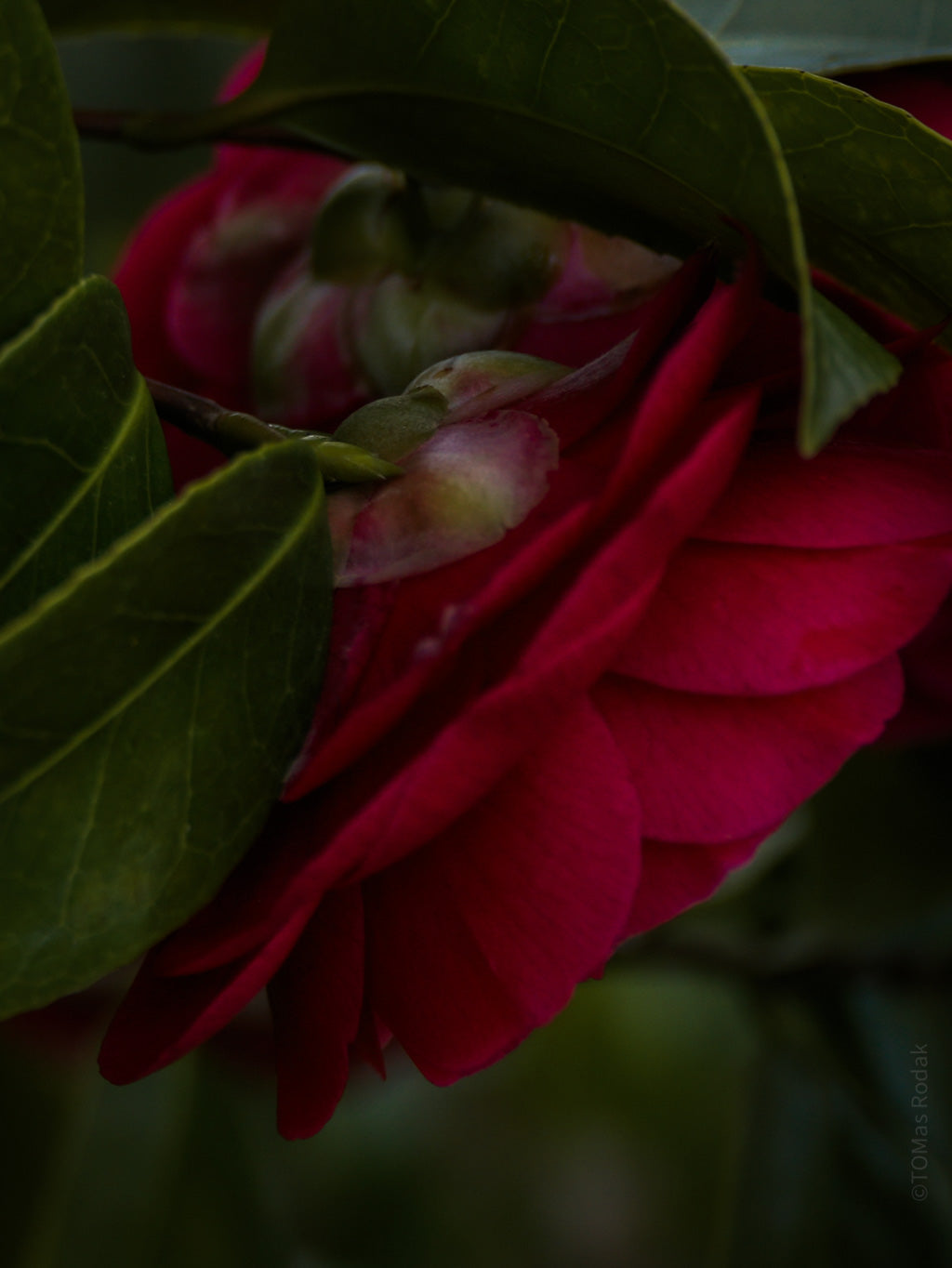
CAMELLIA
Camellias have always fascinated me. They flower when much of the garden is still asleep. Their dark, glossy leaves and beautiful flowers make them hard to overlook, but I find that the more I look at them, the more there is to discover.
I have been surrounded by plants for most of my life, but I still find myself stopping in front of a camellia. Perhaps it is the shape of the petals, the way they overlap, or the contrast between the flower and its dark green leaves. In Japan, camellias have been appreciated for centuries. In Europe, they became particularly fashionable in the nineteenth century, finding their way into gardens, paintings and literature.
I also enjoy travelling to see camellias in flower. Some of my favourite places include the Parco delle Camelie in Locarno, the Parco Botanico del Gambarogno, Villa Anelli in Oggebbio, the gardens of Villa Taranto in Verbania and Isola Madre on Lake Maggiore. Further afield, Parque Terra Nostra in Furnas, on the island of São Miguel in the Azores, is another special place. Its extensive camellia collection, with old and more recent cultivars, makes it a wonderful destination for anyone who shares this interest.
One detail I have always liked is the way some camellias, particularly Camellia japonica, drop their flowers almost whole. Rather than losing their petals one by one, the flower falls as a complete bloom. There is something quite special about that.
When I photograph camellias, I am interested in more than their colour. I look at the shape of each flower, the structure of its petals and the way light falls across them. Sometimes a little light is all it takes to reveal something I had not noticed before.
That is what I try to capture in these photographs.